Building One Baseball Community: A New Approach to Recreation and Travel Baseball
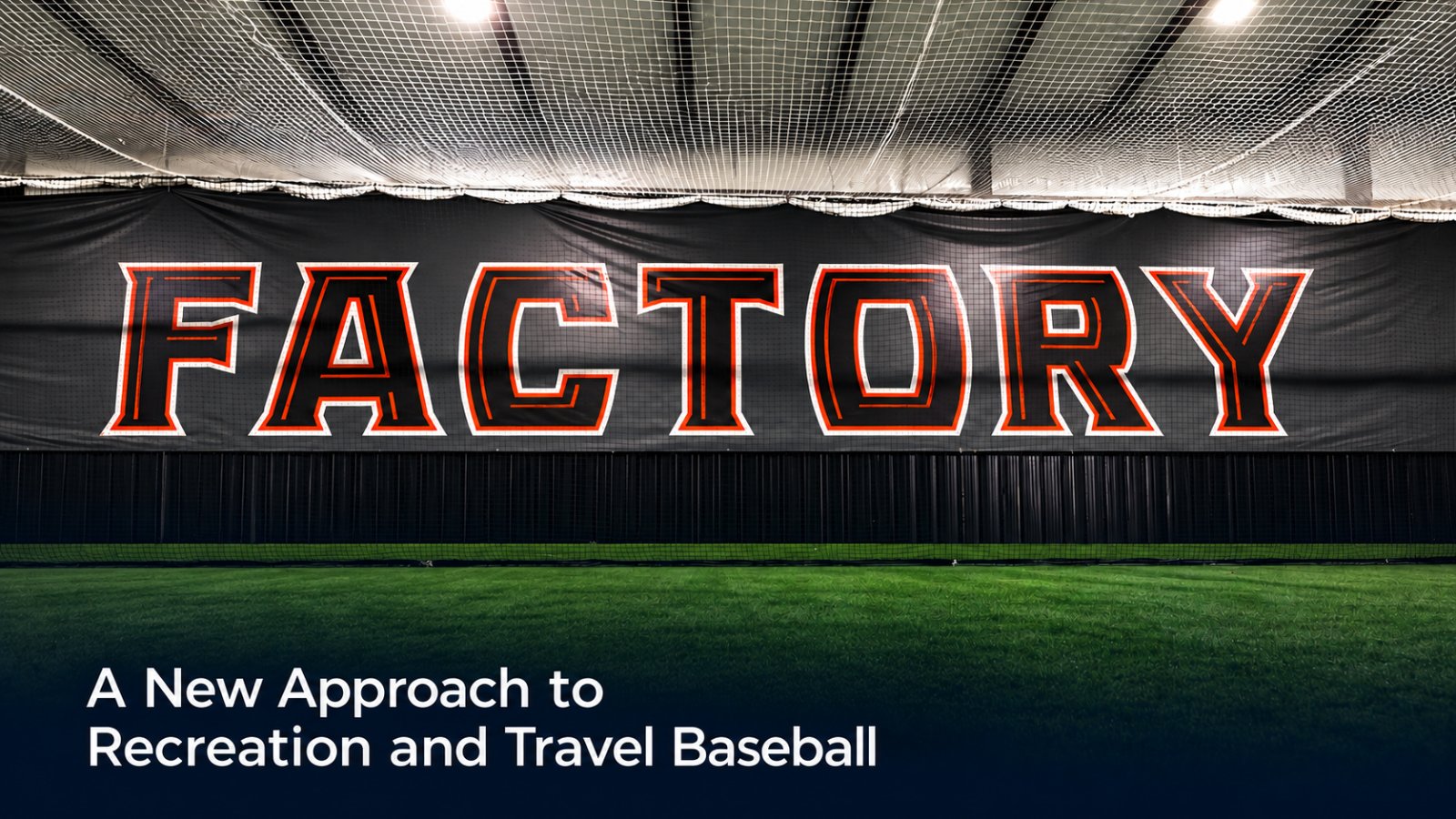
At The Factory Sports Training of Georgia, we believe youth baseball should be bigger than the name on the front of a jersey.
Recreation baseball and travel baseball are sometimes treated as two completely different worlds. We don't believe they have to be.
Our goal isn't to completely change how recreation programs or travel organizations recruit and build teams. We want to introduce an additional approach—one that helps our community better understand each player, track development and create opportunities for young athletes to compete at a level appropriate for where they are in their baseball journey.
We want to help build one baseball community.
Recreation and Travel Baseball Can Work Together
Recreation baseball plays an important role in introducing young people to the game and giving them opportunities to continue playing.
And recreation baseball isn't limited to the youngest players. In some communities, recreation programs continue through 15U and even older age groups.
At The Factory, our baseball program extends through 18U.
That creates an opportunity to build relationships that can follow players from their earliest years of baseball through their high-school-age seasons.
We aren't trying to convince every recreation player to leave recreation baseball and play travel baseball.
We want recreation players to know that The Factory can also be a place where they can be evaluated, receive instruction, measure their development and discover additional opportunities as they grow.
Get to Know the Player Before Categorizing the Player
One of our core beliefs at The Factory is simple:
Get to know the player before you categorize the player.
A recreation player isn't automatically less talented than a travel player. A travel player isn't automatically more talented because of the uniform they wear.
Young athletes develop at dramatically different rates.
- Size changes.
- Speed changes.
- Strength changes.
- Confidence changes.
- Baseball knowledge changes.
A player's ability to hit, field, throw, catch or pitch can change significantly over a relatively short period of time.
That's why we don't believe one tryout should define a young baseball player.
Introducing the Factory Player Assessment
The Factory Sports Training of Georgia is inviting local recreation baseball players to visit our facility and complete a comprehensive player assessment.
Depending upon the player's age, experience and position, the assessment can include areas such as:
- Physical measurements and size
- Running speed and athletic movement
- Baseball experience
- Hitting
- Fielding
- Throwing
- Catching
- Pitching
The information is entered into the player's individual Factory Player Profile.
But that's only the beginning.
We plan to reassess players every 60 days.
That changes the purpose of the assessment.
We're not simply asking:
"How good is this player today?"
We're beginning to ask:
"Where was this player 60 days ago, where are they today, and where are they heading?"
Every 60 Days Creates a Development Story
Consider a young player who continues participating in the assessment program for one year.
Instead of one set of numbers, that player could have approximately six assessment periods showing development throughout the year.
We can begin comparing:
Baseline → 60 Days → 120 Days → 180 Days → 240 Days → 300 Days → 360 Days
Now we can start seeing trends.
- Is the player getting faster?
- Is throwing performance progressing?
- Are hitting measurements changing?
- Is fielding becoming more consistent?
- Has a player begun developing as a pitcher?
- Is a catcher progressing behind the plate?
Are there areas that have remained relatively unchanged and may need additional instruction?
That information becomes part of the player's history rather than disappearing after a single tryout.
Technology Helps Us Measure Development
The Factory has technology and training areas that allow us to add objective measurements to what our coaches observe.
Our indoor facility includes HitTrax, which provides measurable hitting performance information along with video capabilities that can help players and instructors evaluate development at the plate.
Instead of simply telling a player, "You're hitting the ball harder," we can begin looking at measurable information and comparing it with previous assessment periods.
The Factory also has an indoor bullpen that allows pitchers to throw in a controlled environment where pitching performance can be evaluated and instruction can take place.
Technology will never replace coaches.
It gives our coaches, players and parents another perspective.
- The numbers tell us part of the story.
- The coach tells us part of the story.
- The player tells us part of the story.
And over time, the player's profile begins putting those pieces together.
From Youth Baseball Through 18U
The potential becomes even more exciting when we think long-term.
Imagine a player entering the Factory assessment program while playing recreation baseball and continuing to participate every 60 days as they grow.
Their profile could potentially follow their development through:
Recreation Baseball → Additional Training → Travel Baseball → Middle School Baseball
→ High School Baseball → 18U
Not every player's path will look like that.
And that's exactly the point.
There isn't one correct path.
Some players may continue playing recreation baseball for years.
Some may play recreation and receive additional Factory training.
Some may transition into travel baseball.
Some may play school baseball and recreation baseball.
Some may eventually play for a Factory team.
Our job shouldn't be to force every player onto the same road.
Our job should be to help them find the right road.
Better Information Can Help Build Better-Matched Teams
One of our goals for this program is to eventually use developmental information to assist with team formation and competitive balance.
Age matters in youth baseball, but age alone doesn't tell us everything about a player.
Two 13-year-old players can be dramatically different in physical development, experience, speed, arm strength and baseball ability.
The same can be true at 10U, 12U, 15U or 18U.
When coaches have more information—and especially information collected over time—they can make better-informed decisions about where players may fit.
That doesn't mean a computer or a statistic should determine what team a child plays on.
Baseball still requires coaches to coach and evaluate players.
But a player's developmental history can give coaches another tool when making those decisions.
Our hope is that this can help create teams where players have an opportunity to compete, develop and be challenged appropriately.
The Assessment Is Not a Travel-Ball Tryout
We want parents and recreation organizations to understand this distinction.
Bringing your child to The Factory for an assessment does not mean you are signing up for Factory travel baseball.
The assessment has value by itself.
A recreation player can establish a baseline, continue playing recreation baseball, work on specific areas and return approximately 60 days later to see what has changed.
We want parents to be able to see development.
We want players to see development.
And we want coaches to have information that can help guide instruction.
If that player eventually becomes interested in Factory travel baseball, their developmental history can help us better understand them.
But becoming a Factory travel player isn't the required outcome.
Player development is the outcome.
We Want Recreation Coaches Involved
We also want to develop relationships with local recreation coaches and organizations.
They see these players in games.
They know which kids arrive early.
They see who listens.
They see who supports teammates.
They know which players are developing.
They also see things that can't always be measured with technology.
We want Factory coaches, recreation coaches, school coaches and trainers to view themselves as part of the same baseball community rather than competing groups protecting their own players.
The question shouldn't always be:
"How do we get this player on our team?"
A better question is:
"What opportunity does this player need next?"
The Community Needs to Participate Too
This vision extends beyond players and coaches.
Youth baseball needs its community.
Financial sponsorships from local businesses are extremely important, but community support doesn't always require money.
Sometimes supporting youth baseball means simply showing up.
Attend a recreation game.
Come watch a Factory travel team.
Watch a middle school game.
Attend a high school game.
Bring your family.
Buy something from the concession stand.
Cheer for a great defensive play.
Applaud the kid who hustles.
Encourage the player who just struck out and has to walk back to the dugout.
You don't need to have a child on the field to support the young people who are playing on it.
Imagine what our local baseball culture could become if recreation games, travel games and school games regularly had community members in the stands simply because people wanted to
support local kids.
One Baseball Community
The Factory Sports Training of Georgia isn't trying to replace recreation baseball.
We're not trying to tell every young player that travel baseball should be their goal.
We're trying to create connections.
Recreation departments.
Travel organizations.
Schools.
Coaches.
Trainers.
Parents.
Local businesses.
And most importantly, the players.
Baseball gives us an opportunity to teach much more than hitting and throwing.
It teaches preparation, discipline, accountability, teamwork, sportsmanship, leadership, perseverance and respect.
Whether a player's baseball journey ends at 12, continues through recreation baseball at 15, reaches a Factory 18U team, continues into college or goes even further, that young person deserves an opportunity to develop without being defined too early by a label.
Let's measure where they are.
Let's help them understand where they can get better.
Let's measure them again 60 days later.
And then let's keep doing it.
Over time, we're not just collecting statistics.
We're documenting a young athlete's journey.
And when recreation baseball, travel baseball and the community begin working together, we can create more opportunities for the kids all of us are supposed to be serving.
One community. Different teams. One game. One goal: give our kids the opportunity to develop.
The Factory Sports Training of Georgia
Comments
No comments yet. Be the first.
Log in to leave a comment.